
Tip of Day: USB Low Latency setting

NVitorino

Administrator
Staff member
Jan 10, 2024
74
6
72
18
Hi everyone,

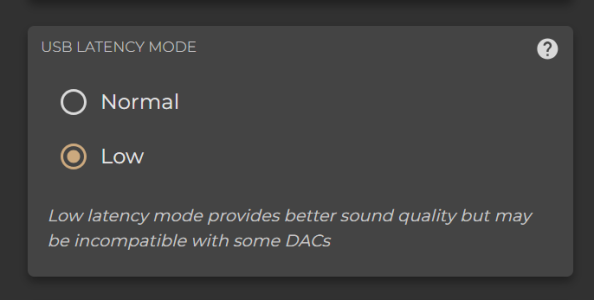
For those connectin their Innuos systems to USB DACs, there is a parameter in System > Settings > Audio called USB Latency Mode:
1721825681392.png

By default, this parameter is set to "Normal" as this is a more safe buffer for DACs to operate. However, setting to Low brings an audible difference in sound quality in our experience. In the past year or so I haven't tried a DAC that didn't benefit from it and I had no issues, to the point we are considering setting "Low" as the standard.

Do give that a try and let me know what you think. If you start hearing "pops" during playback then you are having buffer underruns with your DAC and choosing Normal should resolve that.

Hope this is useful!

Nuno
 
Thanks for clarifying this. I've switched between the two settings but haven't noticed any difference so far. Will now leave it set to Low as recommended.
 
I was about to send my new PS Audio DAC back until I switched to low latency. I was comparing my old PS Audio Perfect WAVe DAc (2012) to this brand new mark 2 version of the Direct Stream and could hardly hear a difference for another 5 grand. The low latency made a big difference
 
  • Like
Reactions: alanrew
Thank you. I am a new user with a Pulse and Phoenix USB feeding the signal to a PS Audio DirectStream Mk 1. I was actually started to look for a DAC upgrade, but tried this setting and it helped. May still look for an upgrade, but I feel like a just got a new DAC from Innuos.
 
Used Innuos with Ayre Dac QB9 Twenty and AquaLaScala Optologic. In my system it is a huge difference between the two modes.
I used to listen in Low all the times. I then visited a friend and he insisted that normal does sound significantly better in his system. While i could not relate to his conclusion I could relate to his observations:
Normal: presents music more as a whole, fuller sounding, warmer colors, tighter and more upfront soundstage (which for some music is very welcome), different tonality (especially apparent when listening to e.g. a violin or massed strings or piano) or maybe better a different focus on the timbre of instruments, air around instruments is warmer more humid -> most of the times, if you do not listen critically better enjoyment of music
Low: bigger soundstage (width and depth and height), you can clearly hear different recording spaces or different artificial reverbs, more details emerge (e.g. hearing the rosin of a violin bow more clearly and hearing the breathing of the violin player), shift of tonality (focus on higher frequencies (low = wood of violin, high = strings), at the same time you hear more of the overall timbres of an instrument (e.g. all the different parts of an concert piano), everything cools down a couple of degrees, overall more exciting but to me not more satisfying (with most recordings) and I hear a slight edge on leading transients.
While I started off, linking the low mode more, I know prefer the normal model much more.
My brother who is a recording engineer prefers the low mode.

How I listen:
If i want to hear deep into a recording space I switch to low. If i want to be emotionally involved I switch to normal. The latter is normal for me.
Regarding the proposition to default "low" I am against it.

Hope this helps.
 
How I listen:
If i want to hear deep into a recording space I switch to low. If i want to be emotionally involved I switch to normal. The latter is normal for me.
Hi 🙂...
Really interesting write-up…
I switched to LOW early in my "InnuOs-career",.and there it has been.

With your writing as a basis,.I will definitely take and compare again.
 
Always used LOW so I just tried to switch on NORMAL.

In my system I have no doubts, LOW is better. Yes a little less forwarded but so natural, refined and textured compared to NORMAL. Reverbs and air around the instruments makes the spaciousness realistic, the venue is part of the performance.
 
Always used LOW so I just tried to switch on NORMAL.

In my system I have no doubts, LOW is better. Yes a little less forwarded but so natural, refined and textured compared to NORMAL. Reverbs and air around the instruments makes the spaciousness realistic, the venue is part of the performance.
Hi Luca,
exact same findings.
I use normal most of the time on electronic music (it has a compressed effect and helps with bass), on Jazz Recordings most of the times Low, on classical Low.
 
Hi Luca,
exact same findings.
I use normal most of the time on electronic music (it has a compressed effect and helps with bass), on Jazz Recordings most of the times Low, on classical Low.
I do have a feeling, that normal sometimes helps with timing/groove of the music. I listened yesterday and I think that is what makes the difference in emotional impact for me. I guess that the statement has a much better timing than the zen.
 
  • Like
Reactions: luca.pelliccioli
Listened with an audio buddy last night and made the test with him and he preferred normal by a huge margin. At least in my system low tends to have more „digititis“ than low.
 
Revisiting this interesting issue.
Low vs normal latency is everything that has been described By Innuos.
For my dac, low latency does indeed result in better SQ.
 
May I ask what is technically doing this parameter? Thanks!

I have a Zenith MK3 connected via USB to a Norma Revo DAC using a Tiglon TPL-2000U cable and I can hear a difference, very similar to what reported Claudius earlier in this thread .
 
It all has to do with the usb implementation of the connected dac. Different dacs implement usb differently.
The basic technicals on the Zen 3 server side are as described by Innuos.
 
May I ask what is technically doing this parameter? Thanks!

I have a Zenith MK3 connected via USB to a Norma Revo DAC using a Tiglon TPL-2000U cable and I can hear a difference, very similar to what reported Claudius earlier in this thread .
In essence, it lowers processing time. This mode reduces the buffer (temporary storage) that needs to get sent to the DAC, so the audio signal gets sent more quickly and reduces delay. However, different DACs have different buffer capacities which is why 'mileage can vary' in terms of compatibility; some systems cannot keep up and 'run out' of buffer which is why you might encounter some stutters/breaks in sound. This is rare these days.
This is also why we ship out units just set to 'normal' by default, to ensure the widest compatibility. Low Latency is a potential upgrade in sound at user discretion; if we were to ship all our units set to a default of Low, then yes a lot of systems will likely sound better straight out of the box, but we will also run into situations where users immediately assume the streamer is broken/faulty, when in fact its just an optional DAC buffer issue. We decide to stay on the safe side!